Claiming the R&D Tax Incentive in Australia: Common Misconceptions

Bruce Murray · Manager, R&D and Government Incentives · 14 April 2025

Last reviewed: June 24, 2026
The Research & Development Tax Incentive (R&DTI) is an invaluable funding opportunity, supporting business innovation and growth. However, claiming the R&D Tax Incentive in Australia can often be misunderstood, leading to missed opportunities or incorrect applications.
In our previous article “Mastering the R&D Tax Incentive: top mistakes to avoid with your application” our R&DTI expert, Bruce Murray, talked to us about common application mistakes.
With decades of direct experience reviewing R&D Tax Incentive applications as a programme assessor within the Department of Industry, Science and Resources (AusIndustry), and a background spanning corporate governance, compliance, and risk management, Bruce's insights carry the weight of someone who has sat on both sides of the assessment process.
For this article, we asked him to share frequent misconceptions around the R&D Tax Incentive and clarify them for us.
Do some business owners believe the R&DTI is only for large businesses?
What do businesses often get wrong about how much time they have to submit their claims?
Is the application process the same for R&D activities conducted outside of Australia?
Key takeaways
A core R&D activity must have an unknown outcome, follow a scientific process, and aim to generate new knowledge.
Company size and industry do not determine eligibility while the $20,000 minimum spend threshold does.
Records must meet the "desktop understanding" standard; being self-explanatory, without needing further input from you.
You have until 30 April to submit, but earlier lodgement means faster processing and quicker access to your rebate.
Overseas R&D activities require a separate Overseas Finding application before they can be included in a claim.
1. The term “core R&D activities” can be misinterpreted when it comes to R&D activities. What does it mean according to the R&DTI program?
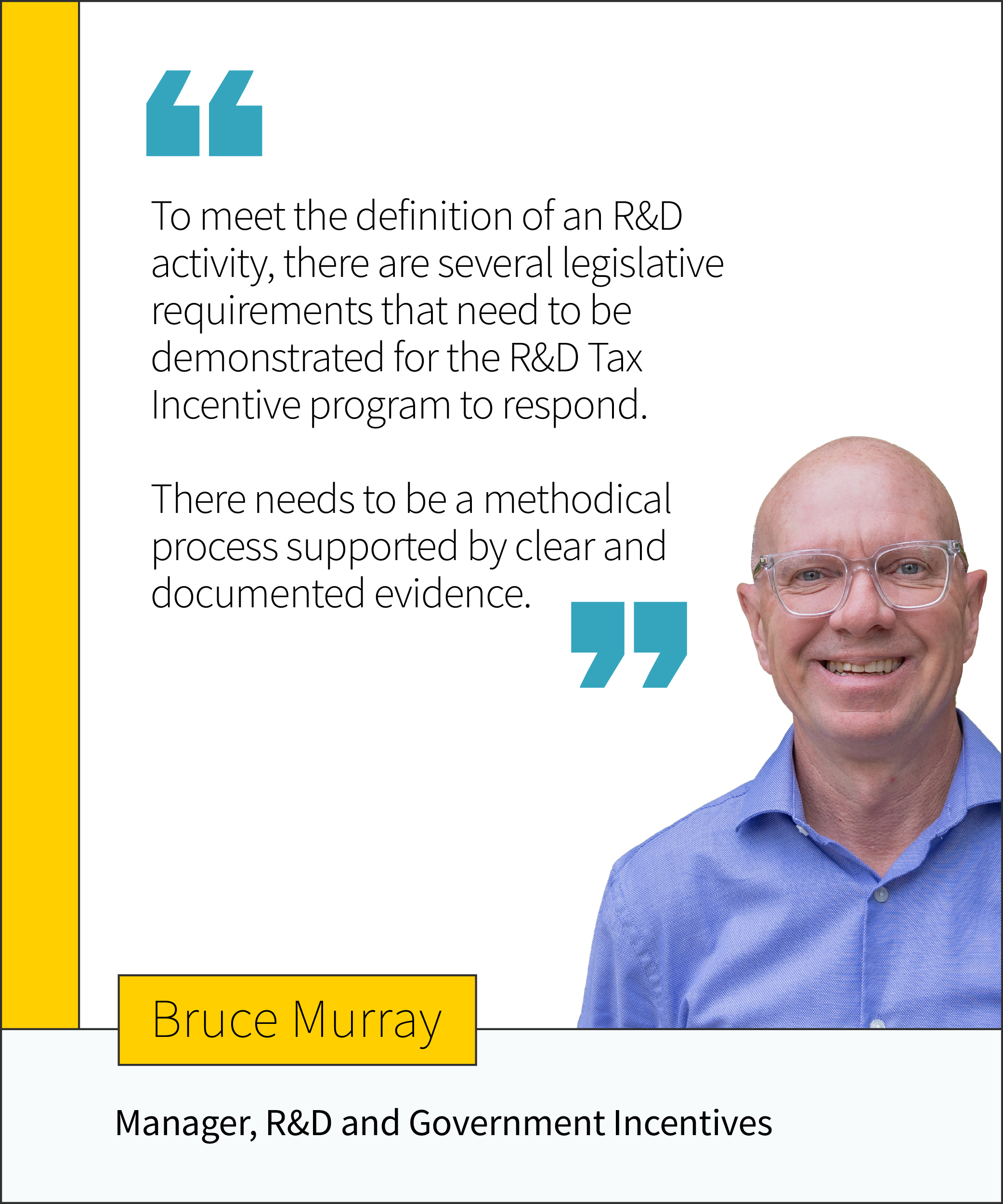
To meet the definition of an R&D activity, there are several legislative requirements that need to be demonstrated for the R&D Tax Incentive program to respond.
Prior to commencement, the outcome of the R&D activity must not have been known or determined in advance by a competent professional in the field, based on current knowledge, information, and experience. This needs to be a true innovation or, in simple words, no one else knows this; no one else is doing it.
The unknown outcome must be determined by applying a systematic progression of work following a scientific process i.e. hypothesis, experimentation, observations, and conclusions. There needs to be a methodical process supported by clear and documented evidence.
Additionally, The R&D activity must be conducted for the purpose of generating new knowledge – where previously there was a knowledge gap, and the R&D project activities were required to address it.
2. Do some business owners believe the R&DTI is only for large business or specific industries?
Definitely, the R&DTI program is not only for large companies. To be honest, the size of the company itself is not that important. Similarly, the sector, or industry type is not an influence on the R&DTI claim outcome.
In October 2025, the ATO released their “R&D tax incentive transparency report 2022–23” in which they noted a significant number of SMEs and smaller companies across all types and sectors of industry.
This means it does not matter what the industry is, nor how large (or small) the company is. So long as anticipated eligible R&D expenditure exceeds the threshold of $20k, an R&DTI application can be considered.
3. How detailed do R&D records need to be to apply successfully for the R&D Tax Incentive?
The records of a company’s R&D activities need to be as detailed and comprehensive as possible and reflect how those activities fit within the overall project.
R&DTI applications are subject to what we call “desktop understanding”. An assessment on merit, on the evidence presented at the time, without needing further explanation from an external source. This allows for objective assessment.
Maintaining organised documentation is crucial for supporting applications and providing evidence if needed. I recommend clients prepare comprehensive documentation in advance to ensure easy retrieval during a possible inspection.
FundFindrs helps you stay audit-ready. We support you in building clear, compliant documentation that strengthens your R&DTI claim.
4. What do businesses often get wrong about how much time they have to submit their claims?
Businesses have up to 10 months after the End of Financial Year (EOFY) to submit their application, with the deadline falling on 30 April each year. However, submitting an R&DTI application shortly after the financial year-end offers several advantages.
Firstly, it provides ample time for thorough due diligence, enabling a more comprehensive investigation and discussion of activities potentially eligible for the R&DTI. Secondly, early submission helps avoid the application backlog AusIndustry typically experiences as the April 30th deadline approaches, thereby increasing the likelihood of a faster processing time.
Finally, submitting the R&DTI Schedule, an ATO document, concurrently with the Company Tax Return (CTR) simplifies the process, facilitates a more streamlined submission, and ultimately enables a quicker rebate, which can significantly improve a company's cash flow.
5. What about R&DTI applications for businesses conducting R&D activities outside of Australia? Is the application process the same?
To claim the R&DTI for related activities conducted outside Australia, your business must first apply for an Overseas Finding.
To be eligible, your overseas R&D activities must meet all five of the following criteria:
The activity must qualify as an eligible R&D activity.
It must have a scientific link to a core R&D activity carried out in Australia.
It must be conducted outside Australia and its external Territories.
You must show that the overseas activity cannot be conducted in Australia due to specific reasons such as the lack of necessary facilities, expertise, or environment
The total cost of overseas activities must be less than the cost of the directly related R&D work undertaken in Australia.
You can find more information from the government’s website for the Australian business community here.
Knowing what activities qualify for the R&D Tax Incentive (and also which do not) can be tricky. Fortunately, FundFindrs’ team of experts is here to help guide your business through its R&DTI application.
Book a FREE consultation with one of our specialists now.
About the author
Bruce Murray
Manager, R&D and Government Incentives
With decades of experience in audit and risk, assessing and approving R&DTI applications with AusIndustry, guiding and supporting businesses through the entire application process, Bruce Murray has supported over 100 FundFindrs clients across manufacturing, pharmaceutical, technology, and other industries, bringing practical insight into a wide range of innovation scenarios. Together with the FundFindrs team, he has also achieved a 100% success rate on eligible R&DTI applications, reflecting a consistent, high-quality approach to assessment and submission.
Frequently asked questions
What three conditions must an R&D activity meet to qualify under the R&DTI programme?
Is the R&D Tax Incentive a grant or a tax offset?
Can a business claim the R&DTI for software development?
What happens if AusIndustry or the ATO audits an R&DTI claim?
Why does submitting an R&DTI application early make a difference?
Related articles
ATO R&D Tax Incentive Transparency Report 2023–24: Key Findings and What They Mean for Australian Businesses
6 Oct 2026
How to Prepare Your FY26 R&D Tax Incentive Claim
29 Sep 2026
Industry Growth Program (IGP): what’s changed, what matters, and who should apply
9 Apr 2026Find out if you qualify
Find out if you qualify
Check your R&D Tax Incentive eligibility in a couple of minutes, or book a free 30-minute chat with one of our consultants.
Prefer to write or call?
- Phone
- +61 2 9072 1720