Proposed R&DTI reforms: what Australian businesses need to know

Bruce Murray · Manager, R&D and Government Incentives · 12 November 2026

On 27 October 2026, Treasurer Jim Chalmers introduced the Treasury Laws Amendment (Tax Reform No. 4) Bill 2026 into the House of Representatives. The Bill passed the House on 29 October and is now awaiting consideration by the Senate, progressing the Australian Government’s proposed changes to the Research and Development Tax Incentive (R&DTI).
The proposed reforms were first announced as part of the 2026–27 Federal Budget, followed by consultation on draft legislation.
If passed, the R&DTI changes are proposed to apply from 1 July 2028. Importantly, the measures are not yet law and could change as the Bill progresses through Parliament.
So, what is being proposed and what could it mean for businesses investing in R&D?
In this article
Key Takeaways
The proposed R&DTI reforms are not yet law.
If passed, the changes would apply from 1 July 2028.
The refundable turnover threshold would increase from $20m to $50m.
Minimum R&D expenditure would increase from $20,000 to $50,000.
Core R&D would receive a higher offset rate.
The treatment of supporting R&D activities would change.
The impact will depend on each business’s R&D activities, expenditure and circumstances.
What is the Government proposing?
The Bill includes a number of changes to how businesses could access and claim the R&DTI.
Key proposals include:
increasing the turnover threshold for the refundable R&D tax offset from $20 million to $50 million;
increasing the minimum R&D expenditure threshold from $20,000 to $50,000;
increasing the maximum R&D expenditure threshold from $150 million to $200 million;
increasing offset rates for eligible core R&D expenditure by 4.5 percentage points;
generally limiting access to the refundable offset to a company’s first 10 years, with an extended period of up to 15 years for eligible therapeutic-goods R&D;
changing the existing treatment of supporting R&D activities; and
reducing the R&D intensity threshold from 2% to 1.5% for accessing the higher non-refundable R&D premium, potentially allowing more larger companies to access the premium rate.
Some of these proposals could expand access to the incentive, while others could change the expenditure businesses are able to claim.
In announcing the Bill, Treasurer Jim Chalmers said : “The reforms to the R&D Tax Incentive better focus the program on core R&D activities that are experimental and contribute to the development of new knowledge, with more generous support for these activities.”
Core vs supporting R&D: why does it matter?
One of the most important proposals is the change to how supporting R&D activities would be treated .
Under the current R&DTI framework, eligible activities can include both core R&D activities and supporting R&D activities where the relevant requirements are met.
In simple terms, core R&D is the experimental work undertaken to generate new knowledge. Supporting R&D covers certain activities that support eligible core R&D and satisfy the program's requirements.
Under the proposed framework, the Government intends to increase the offset available for core R&D expenditure while changing the current supporting-activity framework.
Why is this important?
The cost of an R&D project doesn't necessarily sit entirely within the experiment itself. For businesses with a high proportion of expenditure on eligible core R&D, the proposed higher offset could be beneficial.
However, for businesses whose current claims include significant expenditure relating to supporting R&D activities, the outcome could be different. This means the impact of the proposed reforms could vary considerably depending on what R&D a business undertakes and where its eligible expenditure sits.
The headline rate is only part of the story. Businesses will need to understand how much of their current claim relates to activities that remain eligible under the proposed framework. A higher rate applied to a narrower expenditure base will not necessarily produce a larger benefit.
Bruce Murray
Manager, R&D and Government Incentives
There is also more detail to come. The proposed framework includes a mechanism for certain activities considered integral to core R&D to be designated through legislative instrument.
Businesses should not assume that all expenditure currently associated with supporting activities will become ineligible, or that a higher core R&D offset will automatically result in a larger benefit.
Who should pay attention to the proposed changes?
The potential impact will depend on each company's circumstances, but there are several groups that should follow the reforms closely.
Growing businesses
The proposed increase in the refundable offset turnover threshold from $20 million to $50 million could expand access for some growing businesses.
However, the Government is also proposing limits on how long companies can access refundable offsets, so the increased turnover threshold shouldn't be viewed in isolation.
Businesses with significant supporting R&D activities
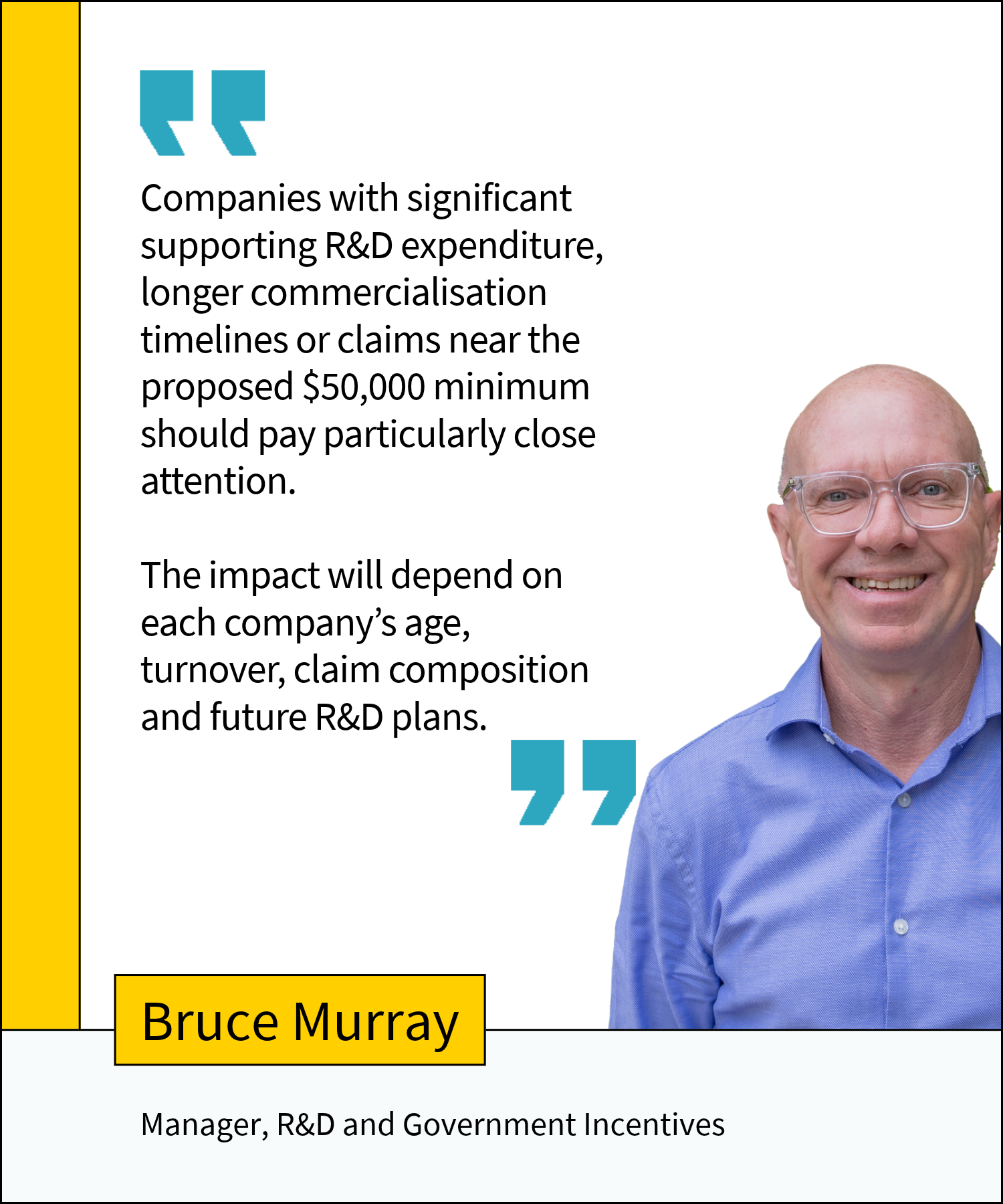
Businesses that currently claim significant expenditure associated with supporting R&D should pay particular attention to how eligible expenditure is defined under the final legislation.
The proposed higher offset for core R&D may not fully offset changes to supporting R&D expenditure for every claimant.
Businesses with smaller R&D programs
The minimum R&D expenditure threshold is proposed to increase from $20,000 to $50,000.
If passed, this could affect businesses undertaking R&D on a smaller scale.
Businesses conducting R&D over longer periods
The Bill also proposes generally limiting access to the refundable offset to a company's first 10 years of operation, with specific provisions extending this to 15 years for qualifying therapeutic-goods R&D.
This could be particularly relevant for businesses operating with long research, development and commercialisation timelines.
What should businesses do now?
For now, the existing R&DTI rules continue to apply.
The proposed reforms are not yet law, and the final legislation may change as the Bill progresses through Parliament.
Businesses don't need to change current R&DTI claims based on the proposals.
However, if you're planning R&D projects that could continue beyond July 2028, it's worth understanding the proposed changes and following their progress.
FundFindrs will continue to monitor the Bill and provide updates as more detail becomes available.
The existing rules continue to apply, so businesses should not change current claims based on proposed legislation. However, companies planning projects beyond July 2028 should note that, for a standard 30 June year-end company, FY2028–29 would be the first financial year affected. This allows three more R&DTI cycles under the current settings, FY2025–26, FY2026–27 and FY2027–28, if the Bill becomes law as proposed. Companies can begin reviewing the composition of their R&D expenditure and modelling possible impacts, while recognising that the legislation may still change.
Bruce Murray
Manager, R&D and Government Incentives
Want to understand what the proposed changes could mean for your future R&DTI claim? If you’d like to understand how the proposed reforms could affect your activities, eligible expenditure or future R&DTI claims, speak with the FundFindrs team. Book a meeting with our R&DTI experts.
About the author
Bruce Murray
Manager, R&D and Government Incentives
With decades of experience in audit and risk, assessing and approving R&DTI applications with AusIndustry, guiding and supporting businesses through the entire application process, Bruce Murray has supported over 100 FundFindrs clients across manufacturing, pharmaceutical, technology, and other industries, bringing practical insight into a wide range of innovation scenarios. Together with the FundFindrs team, he has also achieved a 100% success rate on eligible R&DTI applications, reflecting a consistent, high-quality approach to assessment and submission.
Frequently asked questions
Are the proposed R&DTI reforms law yet?
When would the proposed R&DTI changes take effect?
What is proposed to change for supporting R&D activities?
Will the higher offset for core R&D mean a larger R&DTI benefit?
Do businesses need to change their current R&DTI claims?
Related articles

How to Prepare Your FY26 R&D Tax Incentive Claim
Preparing an FY26 R&D Tax Incentive claim involves more than identifying eligible activities. This guide outlines the key requirements, including entity eligibility, documentation, expenditure tracking and proposed program changes, helping Australian businesses strengthen their R&DTI claims and improve compliance.

ATO R&D Tax Incentive Transparency Report 2023–24: Key Findings and What They Mean for Australian Businesses
The ATO’s 2023–24 R&D Tax Incentive Transparency Report reveals almost $17 billion in expenditure across 13,490 companies. Explore the key findings and what they mean for Australian businesses.